DevNet Expert will soon be called CCIE Automation!
Although this exam used to be known as the DevNet Expert, Cisco has rebranded it to CCIE Automation. The exam structure remains the same: 3 hours for design plus 5 hours for coding and deployment.
The format is unchanged. The CCIE Automation exam also consists of a 3-hour Design and a 5-hour DTDM section
The Cisco Certified DevNet Expert lab exam is Cisco’s most advanced certification for network automation engineers. It’s for people who can write code and design, set up, and maintain automation solutions in complex network environments. It’s like the CCIE of automation, but with Python, APIs, and CI/CD instead of the usual CLI commands.
In this post, we’re going to focus on one key part of the journey, the lab exam format. If you’ve been wondering how to pass the DevNet Expert lab exam, the first step is to understand how the exam is structured, what modules look like, and how scoring works.
Yeah, the lab is tough. But once you understand the format, you can build a plan that actually works. So let’s break it down together.
💡 What is the Cisco Certified DevNet Expert Certification?
This 8‑hour hands‑on exam will soon be called CCIE Automation as part of Cisco’s broader rebranding from DevNet to “Automation”.
The Cisco Certified DevNet Expert is a CCIE-level certification that focuses on network automation. It shows that you can design, develop, test, deploy, and maintain automation workflows using tools like Python, Ansible, REST APIs, Git, and much more. Best of all, it tests real-world skills that you can use every day!
To get certified, you’ve got to pass the 8-hour lab exam. As a prerequisite you have to pass the 350-901 DEVCOR exam first.
If you’re curious what the full exam covers, I’ve broken down the latest DevNet Expert Blueprint (based on the official Cisco site).
🧪 Overview of the DevNet Expert Lab Exam Format
The DevNet Expert lab exam is an 8-hour hands-on exam designed to test both your theoretical knowledge and your practical skills in network automation. It’s split into two distinct modules, and the time for each module is fixed — meaning you can’t finish one early and use the extra time for the other.
The structure looks like this:
- Module 1: Design (3 hours fixed)
- Module 2: Develop, Test, Deploy, and Maintain (5 hours fixed)
Each module focuses on different skill sets. The first is more about planning and designing, while the second tests hands-on coding and network automation. You’ll need to perform well in both to pass, but more on that in the scoring section below.
This diagram gives you a good overview of the two modules as well as what you can expect. But down below we cover each module in more detail.

🧑🎨️ Module 1 – Design (CCIE Automation format, 3 hours)
The first part of the exam is all about designing and planning automation solutions. You’ll work through a series of questions in a web-based interface that looks a lot like CCNA or CCNP-style exams. But don’t let that fool you, the questions are much more complex.
You’ll work with a scenario that stays the same for the whole exam. As you go through it, the scenario changes a bit with each question. New info comes in, and the requirements might change a little. So, with each question, you’ll get more context, like emails from team members, chat transcripts, or other relevant business requirements.
This extra info is really important. If you just read the question and look at the answer options, they might all seem right. The only way to choose the right answer is by taking the scenario and supporting resources into account. So not only do you need the technical know-how, you also need to choose the right solution based on the business requirements.
Question Format
You’ll face different types of questions. Questions could be:
- Single-choice
- Multiple-choice
- Drag and drop
- Matrix-style decision tables
Important Rules
There are two very important rules you need to know upfront:
- You can’t go back, so once you submit an answer, that’s it.
- You won’t see point values
Strategy Tips
And here are some strategy tips that can help you in Module 1:
- Take time to read all provided materials before answering
- Don’t rush, but also watch the time
- Divide your time by the number of questions to estimate how long you can spend on each question.
- When you’re not sure and time is running out, just select the best answer and move on
The first module is more about planning, design, and critical thinking. You will be tested on making architectural decisions, selecting the right tools or technologies given the requirements. This a more theoretical part of the exam, focusing on understanding the big picture of network automation.
But the next module is where the fun begins. That’s where we get practical and start writing some code!
🛠️ Module 2 – Develop, Test, Deploy, and Maintain (CCIE Automation format, 5 hours)
Now we’re moving on to the hands-on part of the exam. And honestly, this is where it gets fun!
Module 2 is a 5-hour exam about developing, testing, deploying, and maintaining network automation code. Unlike the first module, this one is mostly about writing real code. You will write mostly Python scripts, interact with APIs, use tools like Ansible or Terraform, work with technologies like RESTCONF and NETCONF, and troubleshoot broken code or fix CI/CD pipelines.
This module uses a hybrid format:
- Most questions are hands-on coding tasks
- A few tasks may still be web-based, similar to Module 1
You’ll have a lab environment with access to documentation, devices, and whatever tools are needed to complete the tasks. It’s designed to simulate a real-world coding and troubleshooting scenarios.
Key Rules to Know
Here are some key rules for module 2:
- Backward navigation is enabled
- You can freely move between questions
- If you’re stuck, just move to the next task
- Point values are shown
- This helps you decide where to focus your time
- If you only have a few minutes left, maybe go for lower point tasks
Knowing the point values is really helpful. Some questions are worth a lot more than others, so use that to your advantage. If you don’t have much time left, don’t spend it on hard questions that you can’t finish. Instead, go after lower point tasks and maybe get some low hanging fruits.
Strategy Tips
- Immediately verify your solution after finishing a task.
- You only get points if the result is 100% correct.
- If you wait until the end to verify everything, you might run out of time.
- Mark verified tasks as completed.
- That way, you know you can confidently move on without second-guessing or revisiting these tasks.
- If you’re stuck, move on
- Don’t waste too much time on single tasks.
- But write down some notes or comments about where you got stuck. This will make it easier if you need to go back to the question later.
In Module 2, you will have the chance to show what you can do! Here you will actually build and fix real solutions. This module will test your coding skills, your problem-solving mindset, and your ability to stay calm under pressure.
✅ CCIE Automation Lab Exam Scoring
Scoring on the DevNet Expert Lab exam can be a bit confusing at first, but once you understand how it works, it’s pretty straightforward.
Each module is scored independently, and both have their own minimum score and a pass score.
Here’s how it works:
- If you score below the minimum in either module
- You automatically fail the exam, no matter how well you did in the other module.
- If you score above the minimum in both modules, your scores can be combined
- This means a stronger performance in one module can help balance a weaker result in the other.
- However, just passing both modules individually isn’t enough.
- You also need to hit a combined passing score across both modules to earn the certification.
The following graphic better displays how grading works:
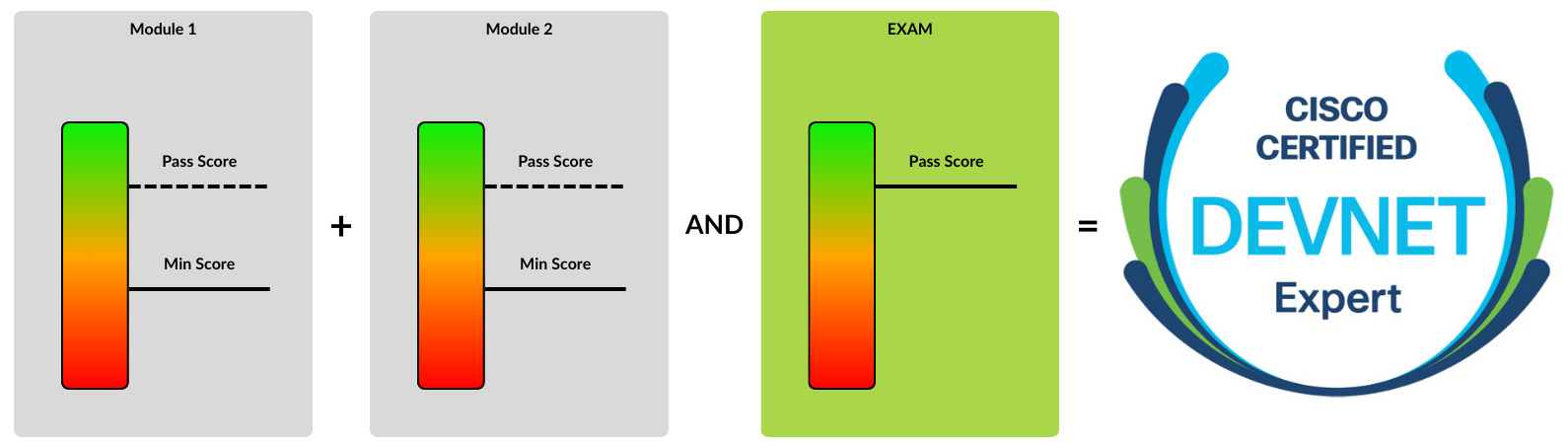
To pass a module, you have to get a score above the minimum. But to pass the whole exam, your overall score needs to be over the pass score. But, and this is where it gets a little tricky, only Cisco knows exactly how many points you need to pass the exam. While Cisco does not publish the exact passing score, in my experience and that of others I’ve spoken with, aiming for about 80% successful task completion gives you a good chance of passing.
🔍 Lessons Learned From My Own Experience
I took the DevNet Expert lab exam myself, and I’ve talked to a lot of my students about it. I’d say it’s one of the toughest certifications out there. It’s not just about knowing how to code or do network automation, but also about applying your knowledge under pressure and in complex scenarios.
Nobody passes this exam on their first attempt. And that’s okay. The exam is designed to test Expert level skills, and it takes time, practice, and a solid strategy to succeed.
If you want to get a real feel for the experience, I documented my exam experience in three dedicated posts. Here is my first DevNet Expert lab attempt, my second attempt as well as my final (and successful) attempt.
And if you want more practical guides, I wrote a dedicated blog post about DevNet Expert Exam Tips and Tricks and How to Build Your Own DevNet Expert Lab.
🚀 Conclusion
The DevNet Expert lab exam is tough. It’s long, intense, and designed to catch you off guard if you haven’t prepared properly. But now that you understand the format, you can better focus on your preparation and avoid some mistakes that cost you a lot of points.
I created DevNet Academy to help engineers like you succeed on the DevNet Expert exam. The e-learning includes theory lessons, hands-on labs, and challenges that mirror the types of tasks you’ll face on the exam.
So if you want to prepare for this exam with a clear strategy and proven resources, check out my DevNet Expert e-learning!