The DevNet Expert Lab exam is an 8-hour practical exam that validates your ability to design, implement, automate, and optimize complex network automation solutions. The exam consists of two separate modules. In this post we will go over the DevNet Expert Lab Exam structure to better prepare you for your first attempt.
Module 1 – Design
This module is 3 hours long. Backward navigation is disabled in this module, so there is no way to go back. You will be given a background story at the beginning. With each subsequent question, you will receive some additional resources, such as an email or chat transcript with a set of customer requirements. If you want to answer a question but don’t read the resources, multiple answers may seem correct. To eliminate some of the possible answers, you must review the resources provided. In the best case, only one valid answer will remain :)
The format of this question is web-based. You can think of it as a CCNP exam, only it’s much more difficult. The questions could be single choice, multiple choice, drag and drop etc. You should be familiar with these question types when you did a CCNP exam.
Time management is crucial for this module so that you can answer all the questions. My recommendation is to make sure that you have 1/3 of the questions answered after the first hour, 2/3 after the second hour, and all the questions answered after the third hour (of course). If you find that you are a little behind schedule, try to work a little faster. But if you are faster, try to be slower and read the questions more carefully. There is a lot of detail hidden in the questions AND the answers. Sometimes it depends on just a few words, and it would be a shame to read over it. And if you finish early, it won’t do you any good. Time will not be credited for the second module.
Module 2 – Develop, Test, Deploy and Maintain
The second module is a 5 hour practical exam. Here, backward navigation is enabled so you can answer the questions in the order you want. If you can’t answer a question, you can just move on to the next one. If you have enough time at the end, you can go back and try to answer the question again. You will always lose some time when context switching between questions. So I wouldn’t jump back and forth too much. The questions in this module are self-contained. This means that if you can’t answer one question, you can still answer all the others.
As the name of this module suggests, you have to develop and test code according to specifications, customer requirements and restrictions. You will also have to deploy and maintain software solutions. This modules consists of both hands-on tasks and web-based questions. So you don’t have to actually code something in each task.
Grading
The grading of the exam is a bit difficult and it took me a while to fully understand it. Both modules are graded individually and each module has a minimum score and a pass score. There are several scenarios that can occur:
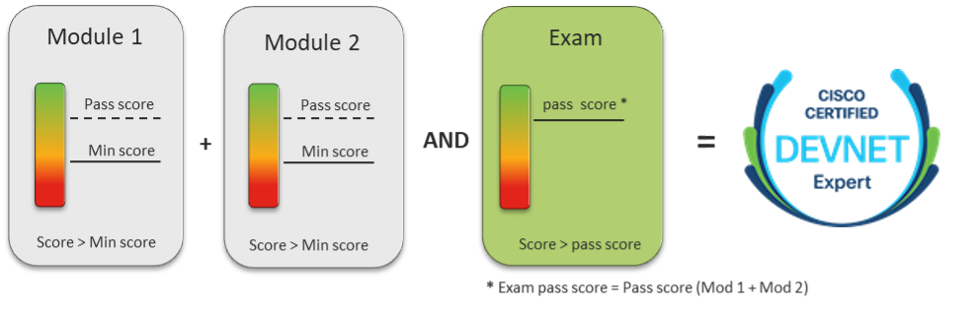
- Below min score in both modules => module 1 fail, module 2 fail, exam fail
- Above min score in one module 1, below min score in module 2 => module 1 pass, module 2 fail, exam fail
- Barely above min score in both modules => module 1 pass, module 2 pass, exam fail
- Above min score in both modules and above exam pass score => module 1 pass, module 2 pass, exam pass
As you can see, it’s a bit complicated to explain the grading. Basically, if things go badly in both modules, you will fail. If you do well in one module but poorly in the other, you will also fail. The only way to pass the exam is if you score above the minimum in both modules and your total score in both modules is above the exam pass score.
I’m familiar with several of these scenarios, but I’ll write about them in another blog post.


Are any resources allowed in the second module (books, notes, …)?
Hi Rouven
In the second module there is a website, in which the documentation for each tool is linked. Otherwise no resources are allowed.
Thanks
Luca